Perverse Taiwan by Howard Chiang Yin Wang
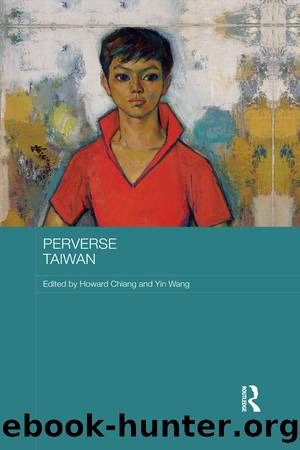
Author:Howard Chiang, Yin Wang [Howard Chiang, Yin Wang]
Language: eng
Format: epub
ISBN: 9781138349995
Barnesnoble:
Publisher: Taylor & Francis
Published: 2018-08-14T00:00:00+00:00
Intersections
The ongoing process of family transition that I have described shapes and is shaped by other institutions and discourses as these emerge and change in the society. In Zhixiongâs narrative, medicalized notions of transsexuality inform family outcomes in implicit and explicit ways, such as Zhixiongâs musing that âsurgery kind of justified everything.â To be sure, the involvement of family in medical decisions has been identified as a major obstacle for people seeking gender-related care in Taiwanâs health care system. Even when family signatures are no longer legally required to obtain medical procedures, doctors often consult family members as a matter of routine, and individuals who cannot procure family signatures encounter obstacles to treatment. For example, doctors may refuse to perform procedures without written parental consent because they are afraid of lawsuits (Ho 2006, see especially footnote 21 on Taiwanese law allowing parents to sue for malicious mutilation of their (even adult) childrenâs bodies). In this way, medical, legal, and family structures work in concert to make determinations about how bodies should be gendered. Add to this that medical models of transsexuality are widely critiqued for their regulatory and colonizing impulses,10 while family and kinship are recognized as normalizing institutions, and the possibilities for transgender self-expression and agency at the intersections of kinship and medicine appear slim indeed.
Yet, as Isaac West (2014) points out in relation to the normative social systems that comprise transgender citizenship, critiquing normativity can become a conceptual dead end when it does not leave room for people to make themselves intelligible within the available discourses. By analyzing the law and citizenship as relational and performative (as I have aimed to do here with patrilineal kinship), West is able to move beyond this conceptual impasse, to analyze how norms are done and undone in everyday life, and how an âimpure transgender politicsâ may appropriate dominant logics as opportunities instead of impediments (2014, 192). There are many possible entry points to such âimpure politicsâ threaded throughout Zhixiongâs life story. I will focus on the intersections of family, medical, and psychiatric discourses in the context of Zhixiongâs hospitalization for severe depression, subsequent surgeries, and post-surgical care. Through this period, processes of negotiation demonstrate how new forms of medical decision-making may symbolically engage the family while also displacing it as a source of authority.
In fact, it was Zhixiongâs mother and brothers who (unwittingly) set the wheels of his medical and legal transition into motion, by breaking into his apartment, where he had locked himself in complete unresponsiveness, admitting him to the hospital, and, when he still refused to speak, revealing his transgender desires to the doctors:
Those doctors and psychiatrists were trying to figure out what was wrong with me. My brother or my mother said something about me wanting to become a man. So, the doctor said to me, âDo you want to change your sex? If you do, please respond. I have ways to help you.â I heard those words and responded. So they began to give me counseling and evaluations.
Download
This site does not store any files on its server. We only index and link to content provided by other sites. Please contact the content providers to delete copyright contents if any and email us, we'll remove relevant links or contents immediately.
| Anthropology | Archaeology |
| Philosophy | Politics & Government |
| Social Sciences | Sociology |
| Women's Studies |
Cecilia; Or, Memoirs of an Heiress — Volume 1 by Fanny Burney(32573)
The Great Music City by Andrea Baker(32038)
Cecilia; Or, Memoirs of an Heiress — Volume 2 by Fanny Burney(31969)
Cecilia; Or, Memoirs of an Heiress — Volume 3 by Fanny Burney(31949)
We're Going to Need More Wine by Gabrielle Union(19062)
All the Missing Girls by Megan Miranda(16080)
Pimp by Iceberg Slim(14542)
For the Love of Europe by Rick Steves(14233)
Bombshells: Glamour Girls of a Lifetime by Sullivan Steve(14090)
Talking to Strangers by Malcolm Gladwell(13394)
Norse Mythology by Gaiman Neil(13387)
Fifty Shades Freed by E L James(13252)
Mindhunter: Inside the FBI's Elite Serial Crime Unit by John E. Douglas & Mark Olshaker(9359)
Crazy Rich Asians by Kevin Kwan(9304)
The Lost Art of Listening by Michael P. Nichols(7516)
Enlightenment Now: The Case for Reason, Science, Humanism, and Progress by Steven Pinker(7321)
The Four Agreements by Don Miguel Ruiz(6772)
Bad Blood by John Carreyrou(6629)
Weapons of Math Destruction by Cathy O'Neil(6292)
